Coffee in the Restaurant and Hotel Industry: The Right Equipment for Different Serving Concepts
Coffee Day is celebrated in Germany on October 1. The event was launched in 2006 by the German Coffee Association. In 2026, it will mark its 21st anniversary and will be celebrated in conjunction with International Coffee Day.¹
Coffee continues to play a significant role in the out-of-home market. In 2025, 125,500 tons of coffee were consumed out of home in Germany. This marked a new record high for out-of-home consumption.²
For the restaurant, hotel, and other commercial sectors, coffee therefore remains an important part of the beverage offerings. When selecting equipment, however, it is important to consider not only the suitability of the coffee machine but also other factors. The desired volume of coffee to be brewed is equally crucial. In addition, the organization of the subsequent serving process must be taken into account.
A breakfast buffet has different requirements than a café, a small coffee bar, or a conference area. This is where the various equipment concepts differ.
Plan coffee service based on actual demand
The way coffee is served can vary significantly depending on the specific establishment.
Serving breakfast to guests at a hotel requires providing a large number of cups within a limited time frame. In a café or smaller dining establishment, however, demand may be more evenly spread throughout the day. At conferences or meetings, there is also the question of whether coffee should be served directly at the machine or at a separate station.
Therefore, it is not just the total amount of coffee that matters. It is also crucial to know when the coffee will be needed and when it will be served to the guest.
For specialty retailers, this perspective provides a solid foundation for advising customers. The size of the machine is not automatically an indicator of its efficiency. For success, it is crucial that the preparation capacity and output align with actual operating conditions.
Provide larger quantities of coffee centrally
For applications with a higher demand for filter coffee, round filter machines operate on a different principle than coffee makers with individual pots.
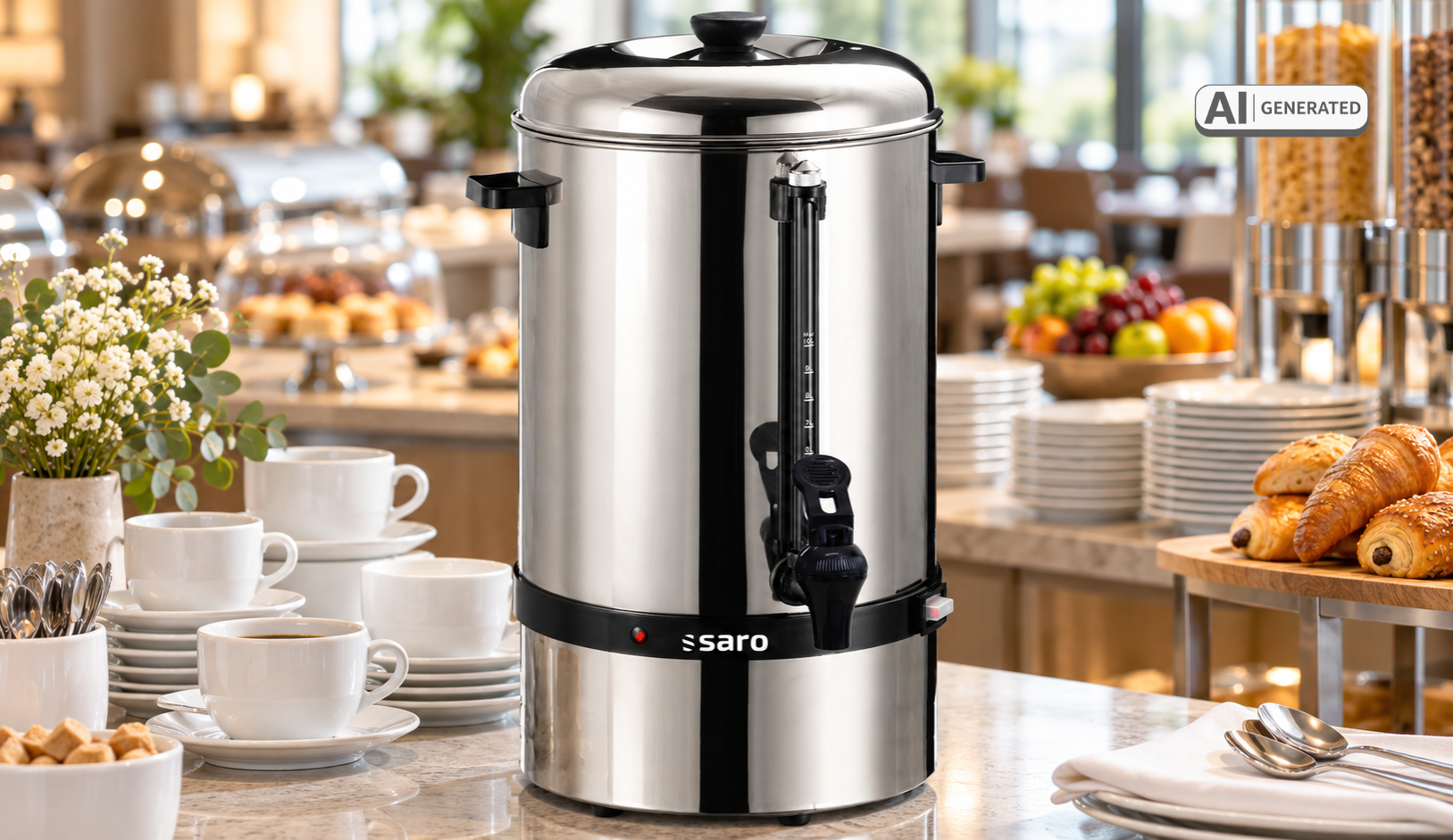
With the SAROMICA 6005, SAROMICA 6010, and SAROMICA 6015 models, the coffee is brewed directly into a larger container and then dispensed through a safety spout.
The three models differ primarily in their capacity:
• SAROMICA 6005 with a capacity of 6.75 liters, or about 40 cups
• SAROMICA 6010 with a capacity of 10 liters, or about 70 cups
• SAROMICA 6015 with a capacity of 15 liters, or about 100 cups
The range of sizes allows you to tailor your order to your actual quantity needs.
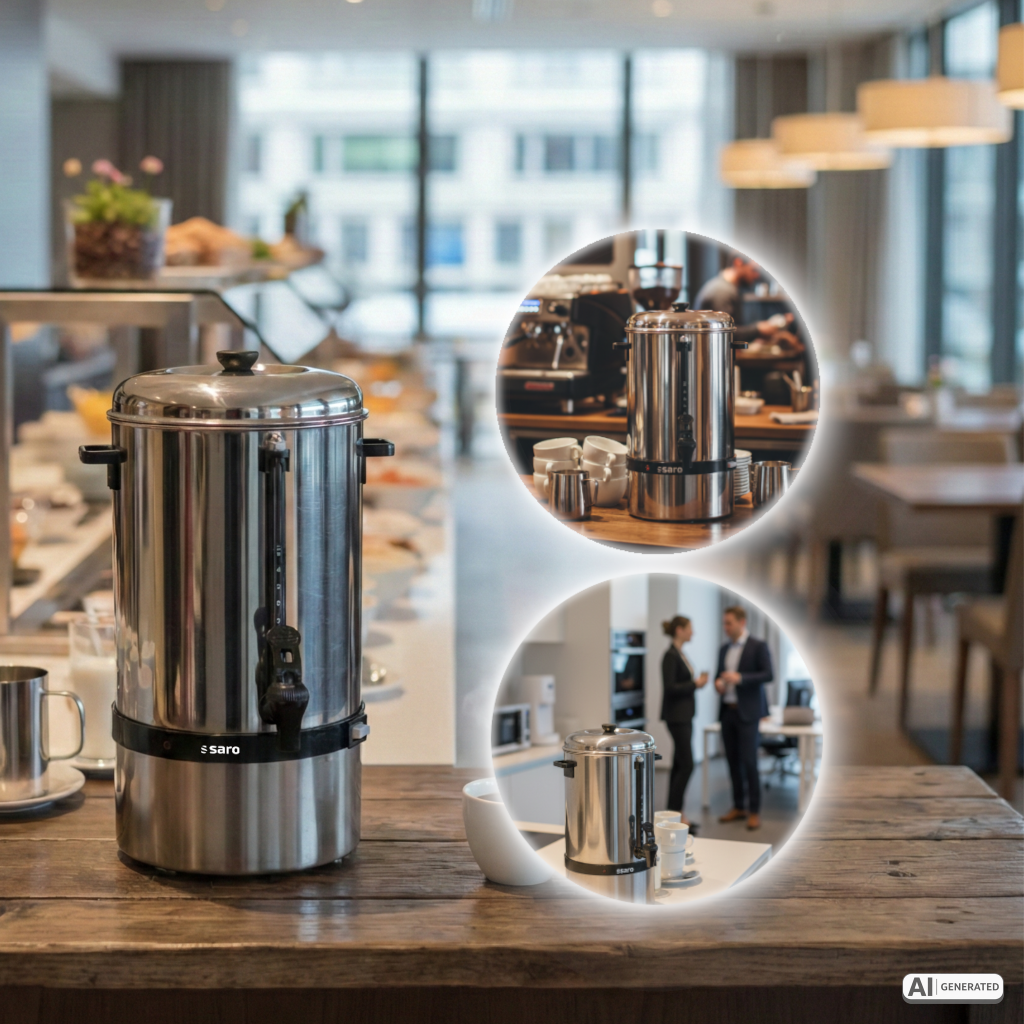
A classic example is the hotel breakfast buffet, where a large quantity of filter coffee needs to be available within a limited time frame. This approach is also useful in cafés, provided that large quantities of coffee are prepared and served centrally. Both of these settings are among the intended applications for the devices.
All three models are equipped with separate heating systems for brewing and keeping the coffee warm. A sight glass makes it easy to check the water level. A fine-mesh filter basket is used for brewing coarsely ground coffee, eliminating the need for additional filter paper.
The main difference from a coffee maker with individual pots lies in the process: A larger quantity is brewed in a single container, kept warm, and dispensed directly from it.
This can be particularly advantageous in situations where a large number of people need to be served filter coffee within a specific time frame.
Prepare smaller quantities in a can
Not every coffee dispenser requires a storage container with a capacity of several liters.
The SAROMICA K 24 T was therefore designed based on a different principle. The unit includes two glass carafes, each with a capacity of 1.8 liters, as well as two warming plates. The brewing time is about five to six minutes.
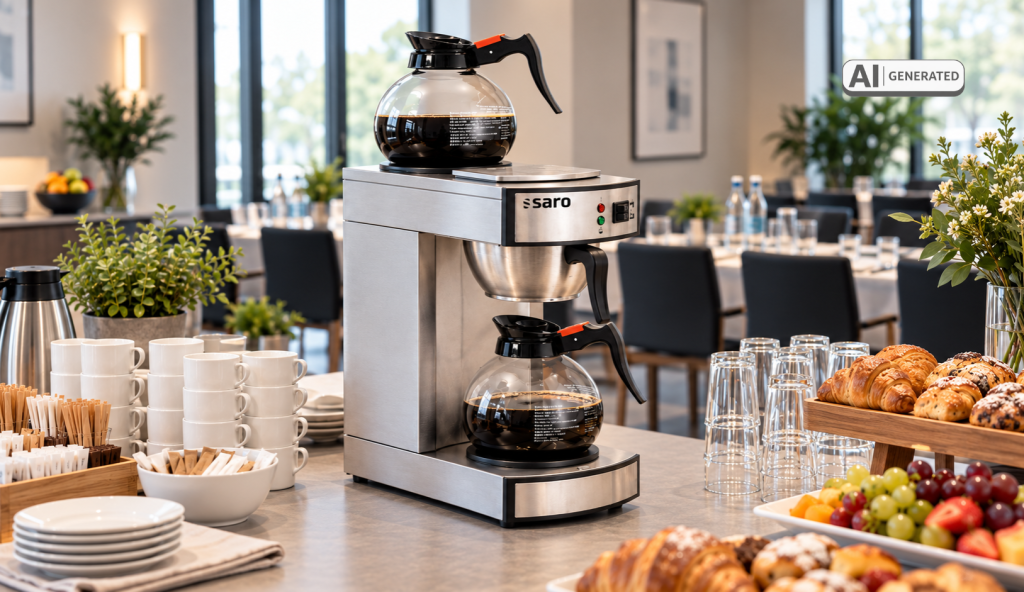
This makes it possible to prepare smaller quantities by the pitcher and keep them warm on the two hot plates.
This principle may be suitable, for example, for a small café where coffee is needed on a regular basis, but where a larger quantity of 6.75 liters or more is not required on a permanent basis. In addition, it is possible to offer a service in which individual pots are prepared as needed.
What matters is not the industry, but the workflow. The requirements for a coffee machine generally depend on the number of cups that need to be served at the same time.
This distinction is particularly important during a consultation to clarify the differences between a round-filter coffee maker and a traditional filter coffee maker.
When preparation and serving take place separately
The SAROMICA THERMO 24 is distinguished by a different operating principle. The coffee is brewed directly into a stainless-steel insulated pump-action carafe with a capacity of 2.2 liters. The brewing time is about five to six minutes.
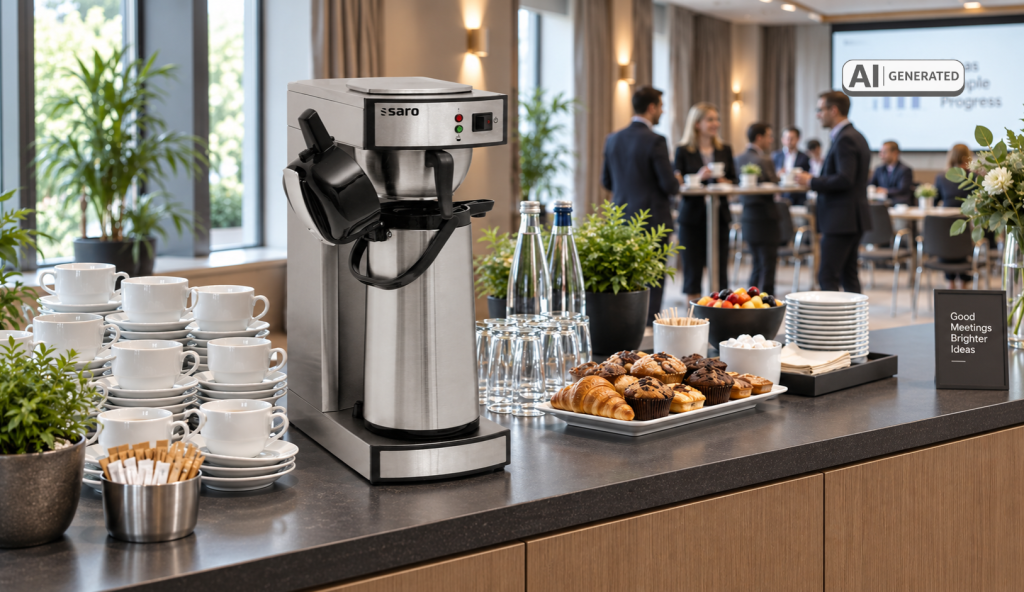
The main difference from the version with a glass carafe lies in how it is subsequently served. The insulated pump carafe is designed for use without a warming plate and can be placed at a suitable serving station after brewing.
This opens up new applications in which food preparation and serving take place in separate areas.
A typical scenario is a conference or seminar area. The coffee is brewed outside the event room. It is then served in a pump pot at a coffee station or in the break area.
The same principle can also be applied to meetings or smaller events where coffee isn’t supposed to be served continuously right next to the machine.
This approach can also create multiple dispensing points within a hotel. The key advantage of this device design is that the filled pump jug is not tied to a hot plate and can be flexibly positioned wherever the coffee is needed.
Self-service as a separate pickup area
Especially in the context of conferences, breakfast buffets, or other self-service setups, it is often not enough to simply set out a pot
In addition to coffee, you’ll need cups, mugs, spoons, stir sticks, milk, and sugar. Grouping these items in one central location makes for a clearer layout.
The LEO 2 coffee station was designed specifically for this purpose. It features storage compartments for cups, spoons, stir sticks, milk, sugar, and other accessories. Pots with a diameter of up to 190 millimeters can be integrated into the station. A removable plastic insert allows for adjustment to different cup heights. It also includes a removable drip tray.
When combined with a suitable insulated pump jug, this allows you to set up a compact serving station in a conference area, a breakfast area, or at a separate self-service station, for example.
In this case, it becomes clear why coffee service shouldn’t be planned solely around the coffee machine. Ultimately, it’s the total cost that matters to the guest.
Use accessories where they support the process
In addition, it is possible to integrate additional accessories as part of a coffee service. However, it is important to note that each element must always serve a specific purpose within the overall concept.
One example is the ATHOS cup warmer. This model can hold approximately 72 cups and features two shelves for cups, saucers, and other suitable items.
If there is increased traffic at the coffee station, cups can be provided centrally. However, the need for such a device depends on the specific setup and the number of cups dispensed.
Other items include, for example, insulated pump pots, glass pots, hot plates, and matching basket filter paper.
Die sinnvollen Ergänzungen ergeben sich aus der konkreten Ausgabesituation. Eine Selbstbedienungsstation mit Pumpkanne erfordert andere Komponenten als eine Kaffeemaschine, bei der die Glaskannen direkt am Gerät stehen.
For specialty retailers, it is advisable to look beyond the individual main unit. Accessories should not be added indiscriminately.
Four points to help you make your choice
The various device concepts can be distinguished from one another based on a few basic criteria.
The required quantity determines, first and foremost, whether individual containers will suffice or whether larger quantities need to be available at the same time.
The time required helps determine whether coffee should be brewed in individual servings or prepared in a larger batch.
The type of serving vessel determines which option works best for the process: a glass carafe with a warming plate, a larger container with a tap, or an insulated pump carafe.
Last but not least, the dispensing station must also be taken into account. Depending on the design, additional elements such as a coffee station, a cup warmer, or other accessories may be required.
This provides a significantly better basis for decision-making than simply comparing liter ratings and power ratings.
Different approaches instead of a one-size-fits-all solution
Coffee service requirements vary greatly depending on the setting—such as a hotel, breakfast area, café, small restaurant, or conference area.
The SAROMICA 6005, 6010, and 6015 round filter machines allow you to combine the brewing, warming, and dispensing of larger quantities of coffee in a single machine.
The SAROMICA K 24 T uses individual glass carafes and warming plates, allowing for more precise portion control during preparation.
With the SAROMICA THERMO 24, the coffee is brewed directly into an insulated pump-action carafe. This makes it possible to separate the dispensing area from the brewing area.
After all, products like the LEO 2 coffee station and the ATHOS cup warmer don’t complement the brewing process itself, but rather the organization surrounding the serving of coffee.
For restaurant and hotel owners, this means that equipment should be selected with actual operations in mind as much as possible. For specialty retailers, this distinction provides a solid foundation for assessing customer needs and putting together suitable components.
Coffee Day is the perfect opportunity to take a closer look not only at the beverage itself, but also at the technology and organization behind it.
Please note that you can find the complete product line in the “Coffee Makers and Accessories” category.
Sources
¹ Deutscher Kaffeeverband e. V.: „Tag des Kaffees“, 2026 https://www.kaffeeverband.de/de/tag-des-kaffees
² Deutscher Kaffeeverband e. V.: „Deutscher Kaffeemarkt 2025“, veröffentlicht 2026. https://www.kaffeeverband.de/de/presse/deutscher-kaffeemarkt-2025-stabil-segment-ganze-bohne-in-zehn-jahren-mehr-als-verdoppelt-all-time-high-konsum-ausser-haus